


Resin Rabbit Statue
Description
Technical Parameters
Your Leading Hangzhou Zaizuo Cultural & Creative Co., LTD. Supplier
Hangzhou Zaizuo Cultural & Creative Co., LTD was established in 2013. Our company specializes in the manufacturing of decorative home accessories, development and production. With more than 10 years of research and development, we are one of the well-known leading enterprises in the home accessories chain in China. Our company mainly deals in home decorations, decorative pictures, trending toys and so forth. We have more than 1000 original designs products. We also have our own subsidiary brand such as "Palmtree", "Yingsen", "Yuncan". All of our products comply with international quality standards and are greatly appreciated in a variety of different markets throughout China.
Why Choose Us?
Excellent after sales support
We offer a comprehensive after-sale policy in the unlikely event that you are not 100% satisfied with any delivered. Such as product use, installation and other aspects, as well as perfect solutions to various product-related problems encountered by customers.
Wide range application
Our products are not only suitable for home decoration but are also widely used in the decoration of companies, stores, hotels, shopping malls and other places.
On time response
If you are interested in any of our products or would like to discuss a custom order, please feel free to contact us. We are looking forward to forming successful business relationships with new clients around the world in the near future.
Strong production capability
We have our own factory covering an area of 10,000 square meters and employing more than 300 employees. Our well-equipped facilities and excellent quality control throughout all stages of production enable us to guarantee total customer satisfaction.


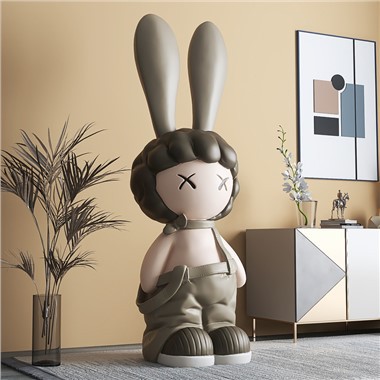

What is Resin Rabbit Statue?
A resin sculpture is a piece of three-dimensional art that has been cast using fiberglass resin. Resin is fairly lightweight. It is a durable material that can be painted and glazed to look like stone, porcelain, bronze or marble. Resin is used to manufacture a wide variety of products.
Durability: Unlike other materials, resin exhibits exceptional strength and resilience, allowing it to withstand the harshest environmental conditions. Extreme temperatures and humidity, which often pose a threat to sculptures made from other materials, are no match for resin. This remarkable durability ensures that your resin sculpture remains intact and retains its beauty for years.
Versatility: Thanks to resin's adaptability, you can explore various techniques and styles. Resin can mould itself accordingly, whether your artistic vision leans towards a realistic representation or an abstract creation. As a result, your sculpture will exhibit a visually enticing and lifelike appearance. From delicate sculptures to abstract masterpieces, resin offers endless possibilities.
Lightweight: Being lightweight, resin sculptures are incredibly easy to handle, transport, and display. Unlike heavy stone or metal sculptures, the use of resin provides you with the freedom to create large-scale pieces without the structural limitations imposed by heavier materials. The lightweight nature of resin sculptures also opens up avenues for creative experimentation.
Transparency: One of the critical advantages of using resin is its ability to offer transparency. Transparent resin allows light to pass through, resulting in intriguing visual effects and captivating reflections that enhance the overall aesthetic appeal of the sculpture.
Colour options: Resin brings a plethora of colour options to the table. You can add pigments and dyes to resin, enabling you to infuse your sculptures with vibrant and vivid colours. This opens up a whole new world of possibilities, allowing you to create stunning, dynamic pieces that indeed come to life.
Types of Resin Rabbit Statue
Epoxy resin
Epoxy resin is a clear liquid plastic made of two parts: the resin and hardener, sometimes referred to as Part A and B, or the base and catalyst. Mixing the two prompts a chemical reaction that causes the mixture to cure from a liquid into a solid material. This process typically takes 24-72 hours and once cured, epoxy resin is rock hard, durable, and resistant to chemicals and moisture.
Casting resin
Casting resin is ideal for projects that require a thick, transparent layer of resin. It is a low viscosity resin, meaning it has a water thin consistency. This makes it easy to pour into small spaces or molds and allows bubbles to rise to the surface for a crystal clear cure. Its thin consistency means that the resin has a longer cure time: it can take up to a week to fully cure, depending on the thickness and temperature. Casting resin is prized for its clarity but can be tinted with liquid or powdered pigment for a colorful effect.
Polyurethane resin
Polyurethane resin is a two-component system that cures to a solid, rubber-like plastic. It is a very durable product used in industrial applications such as the manufacture of adhesives, coatings, insulation, elastomers, sealants, casting molds, and urethane foam. Polyurethane resin is a versatile material formulated to meet specific physical and chemical requirements. As a result, different types of polyurethane resin are used across many industries, including the appliance, automotive, apparel, packaging, and construction industries.
UV resin
If you have ever worked with jewelry, you may be familiar with UV resin, a synthetic resin that cures quickly when exposed to ultraviolet light. UV Resin can be tinted but is most often used as a clear topcoat on a wide variety of surfaces, including wood, metal, plastic, and fiberglass.
Unlike epoxy resin, which requires two parts that must be combined, UV resin is made up of only one component and requires no mixing. It sets very quickly using ultraviolet light, making it ideal for applications that require a quick turnaround time.
Polyester resin
Polyester resin is a type of plastic known for its high strength, rigidity, and water resistance. The resin can be used for several purposes, including laminating objects and manufacturing automobile parts, boat hulls, swimming pools, ponds, molds, models, and certain medical devices.
Like epoxy resin, polyester resin requires adding hardener to resin to initiate the curing process. However, as the amount of hardener added determines the curing time, calculating the mixing ratios can be challenging.
Process of Resin Rabbit Statue
Choose your resin wisely
Before you can start customizing your sculpture, you need to select the right type of resin for your project. There are several different types of resin available on the market, each with its own strengths and weaknesses. Epoxy resin, for example, is known for its durability and clear finish, while polyester resin is more affordable and dries quickly. Make sure to research each type of resin carefully to determine which one is best suited for your specific project.
Consider the base color
Resin sculptures can be cast in a variety of colors, from clear to opaque. The base color you choose will set the tone for the rest of your customization process. Consider what colors will complement your overall vision, and whether you want a transparent or opaque finish. If you're unsure, try experimenting with small batches of resin to see what works best.
Add pigments and dyes
Once you've chosen your base color, it's time to start adding pigments and dyes to achieve the desired shade. Pigments and dyes can be purchased in a variety of colors, and can be mixed together to create custom shades. To ensure the best results, make sure to add pigments and dyes gradually, mixing thoroughly after each addition until you achieve the desired hue.
Incorporate glitter and other embellishments
If you're looking to add some sparkle and shine to your resin sculpture, consider incorporating glitter or other embellishments. Glitter can be added directly to the resin mixture, or sprinkled on top once the resin has been poured into the mold. Other embellishments, such as dried flowers or small trinkets, can be embedded in resin for a unique and personalized touch.
Experiment with different molds
The mold you choose for your resin sculpture can have a significant impact on its final appearance. Experiment with different mold shapes and sizes to see what works best for your vision. You can even create your own custom mold using silicone or other mold-making materials.
Sand and polish the surface
Once your resin sculpture has cured, it's time to sand and polish the surface to achieve a smooth and polished finish. Start by using coarse sandpaper to remove any rough edges or imperfections, then gradually work your way up to finer grit to achieve a smooth surface. Finish by using a polishing compound to bring out the shine and luster of your sculpture.
How to Maintain Resin Rabbit Statue
Prevent from dropping
Resin is quite fragile compared to bronze or marble. A bad fall can break your resin statue. And even if it doesn't break, there is a good chance it might bend out of shape. And a distorted statue can cause as much heartbreak as a broken one can. So, to prevent your favorite statue from breaking or bending, keep it in a safe place.
Keep away from heat and flame
Resin – especially, polyester resin or, polyresin – is prone to heat and flame. They can become explosive and cause little hazards when in contact with fire. Make sure you keep your statues away from these hazardous substances.
Cold temperature
When resin comes in contact with freezing temperature, the harsh weather can cause damage to the outer surface. Although, you can use appropriate paint or sealer to protect the outer layer of your resin statues. But, it's safe to say that the best option is keeping the statues indoor whenever winter hits hard.
Protect from water
Resin is generally waterproof, but even too much water over time can harm your sculptures. Especially, if you are keeping your statues outdoor, use paint to coat the outer layer to ensure it's completely waterproof. Even then, repaint your statues in a few months to keep the sculptures looking new.
Use acrylic
The best kind of paint for your resin sculpture is acrylic paint. It's waterproof so it won't melt or peel off your resin statues. You can also have fun with painting your statues by glazing to give them different looks.
Cleaning
We cannot forget the cleaning part while we are talking about protecting your resin sculptures. To keep your statues shining and new, clean them with mild soap and warm water. And afterward, dry the statues completely. Make sure to clean every nook and corner so the dirt comes off completely.
UV Protectant
If yours an outdoor sculpture made of resin, then use a UV protectant spray to protect it from the harsh rays of the sun. UV rays can cause the paint or the coating of the statues to come off and make them look ugly.
Resin statues and plastic statues are two common materials used to make decorative or collectible figurines. While they may appear similar, there are several significant differences between the two materials that affect their appearance, durability, and value.
Resin is a synthetic material made from a combination of organic compounds, typically reinforced with a filler material such as glass fibers. Resin statues are typically cast in molds, which are filled with liquid resin that hardens as it cures. Plastic statues, on the other hand, are typically made from a variety of synthetic polymers, including polyethylene, polypropylene, and PVC. They are typically molded using injection molding or blow molding techniques.
One of the most noticeable differences between resin and plastic statues is their weight. Resin is a denser material than plastic, which means that resin statues are typically heavier and more substantial than their plastic counterparts. This extra weight can give resin statues a more premium feel and can make them more durable and resistant to damage from accidental bumps or falls.
Another significant difference between resin and plastic statues is their appearance. Resin statues are typically more detailed and have a higher level of fine detail than plastic statues. This is because resin is a more malleable material than plastic, which means that it can be more easily shaped and molded into intricate designs. Resin statues can also be painted and finished to a higher standard than plastic statues, which can give them a more polished and refined look.
In contrast, plastic statues are typically more simplistic in design, with fewer intricate details and a more cartoonish or stylized appearance. This is because plastic is a less malleable material than resin, which means that it can be more difficult to mold into complex shapes and designs. Plastic statues are also typically painted using a more basic paint application process, which can result in less vibrant colors and less detail.
Durability is another important factor to consider when comparing resin and plastic statues. While both materials are relatively durable and resistant to damage, resin statues are generally considered to be more robust and long-lasting than plastic statues. This is because resin is a denser and more substantial material, which means that it can withstand more wear and tear over time. Plastic statues, on the other hand, can be more prone to cracking, chipping, or warping over time, especially if they are exposed to heat or direct sunlight.
Value is also an essential consideration when comparing resin and plastic statues. While both materials can be used to make high-quality collectibles, resin statues are generally considered to be more valuable and collectible than plastic statues. This is because resin statues are typically more detailed, have a higher level of finish, and are more durable than plastic statues. They are also more challenging to produce, which means that they are typically sold at a higher price point than plastic statues.
Our Factory
We have our own factory which has been established for nearly 10 years. Covering an area of 10,000 square meters, with more than 300 employees. Our well-equipped facilities and excellent quality control throughout all stages of production enable us to guarantee total customer satisfaction.


FAQ
Hot Tags: resin rabbit statue, China resin rabbit statue manufacturers, suppliers, factory, Tray Figurine Statue, Resin Dog Statue, Floor Statue For Living Room, Large Statue For Living Room, Sculpture For Living Room, Resin Statue
Previous
No InformationSend Inquiry


